An auctioneer and her hammer have a conversation in a Paris Café
by Celia Zehetgruber and Linus Berg
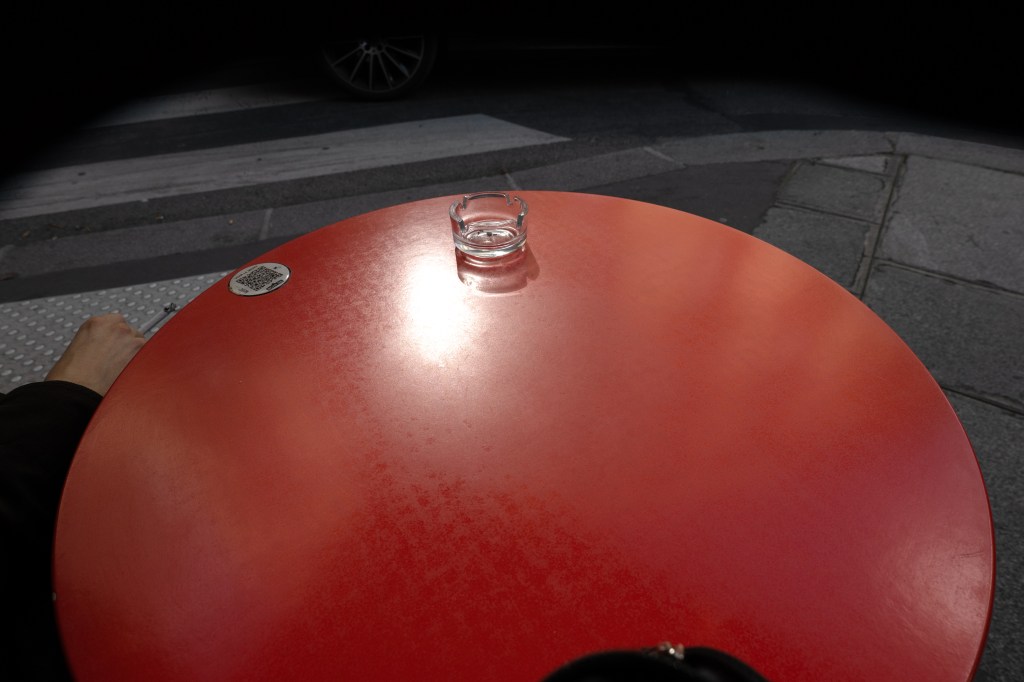
It’s September 2024. An auctioneer and an auction hammer are sitting outside a café in the government district of Paris after an intense series of auctions, watching the scene. They are drinking café au lait and smoking Gauloises.
Hammer: This was a long morning in the auction house. My head’s still hurting after the big surrealism sale…
Auctioneer: Finally we’ve sold that post card scandaleuse – signed by Brigitte Macron herself to her gay lover. Your head must be burning right now.
H: The Café Au Lait is curing me.
A: Say, do you feel like I hit your head too hard? I will try to be more gentle today.
H: You tend to use my right side too much. Try hitting my other side at times. I would also like to be knocked from above or below for a change – depending on how you take it.
A: Oh I’m sorry. I sometimes get so carried away, it just takes over in my body.
H: You are la maestra and the buyers are your orchestra.
A: Sometimes I’m even tempted to throw you.
H: Throw me? On someone specific?
A: Actually there’s someone I would like to slap left and right. He’s been here for some time already, a representative of Sam Altman.
H: Doesn’t it bother you that nowadays it’s always someone’s middleman on the phone? I miss seeing the actual buyers. They are only executors and stand-ins.
A: C’est comme ça! Bien sur, the auction is the moment that counts, but most of my time I spend preparing the performance and curating. For example, maintaining my relationships to clients. The house is connected internationally, so it is of utmost importance to always be vis à vis avec les clients. Of course they like to remain anonymous and often they don’t even have the time to come by. Still, a personal relationship is important. It’s part of the auction.
H: The gathering of the rich.
A: They pay especially for this human connexion, an integral element of the history of the artwork. We have l’auteur, leur signature – mais aussi the moment of sale and their owners. There have been artists refusing their own signature and instead requesting for everyone who ever acquired the work to sign the work with their names. So it becomes more about the hands the artwork passed.
H: It reminds me of this exhibition I saw in Frankfurt where the works were titled after their owners. In the end it was an art sale exhibited as a work of art, if I remember correctly. My brain is shattered from all the banging.
A: Interesting. Some artists dedicate their works, others name them after people. The dynamics of belonging…
H: Makes me think about the framing of works. The frame always holds a certain distance and protects the art from being hijacked by buyers, institutions and other authorities. Creating your own little space, your own little world behind glass. Faire une différence through framing in contrast to affiliation. Not using a frame means handing over all responsibility to the owners.
A: I find that a bit esoteric. Behind the glass blows the same wind as in the auction hall. First and foremost, I look at the frame as a commercial frame, ça veut dire the complete commodification of the piece, which makes the hijacking possible in the first place. It delivers it towards the commodity fetish, which long ago replaced aura which perhaps only existed in the past. You’re not wrong, the frame creates distance, but in the moment of framing it turns into a container, a product.
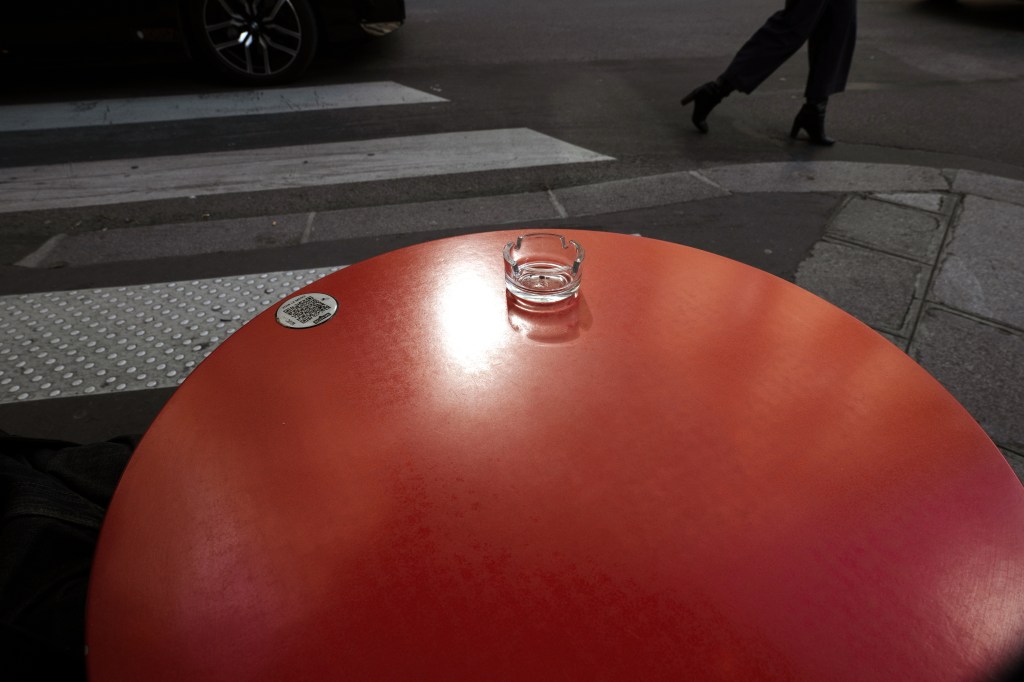
A woman wearing stilettos, Minnie Mouse ears and holding 99 Minnie Mouse balloons walks past the two café au lait drinkers. She is followed by a photographer as she crosses the street.
H: Do you think artists working with scores are more resistant to becoming products? They anticipate the independence of their works when they hand over production and follow-up maintenance directly to the institutions… Perhaps this way the work remains dust-free and can always be reinterpreted according to the times. On the other hand, one must first be comfortable with being part of a larger art complex; that everyone is working on la même grande œuvre d’art.
A: A loyal client, la comtesse once told me that besides the physical intervention of the artist themselves, other mechanisms of value production take effect, such as documentation. It is those relics, witnesses and residues that are then given the commodity form. It makes it easier to integrate those artists in our house, to our benefit!
H: In that case the role of the frame is delegated to me, with one smash of my head. I conclude their status as an art commodity.
A: You are the last resort!
H: After you have accepted the final bid, my word is the climax that seals the spectacle.
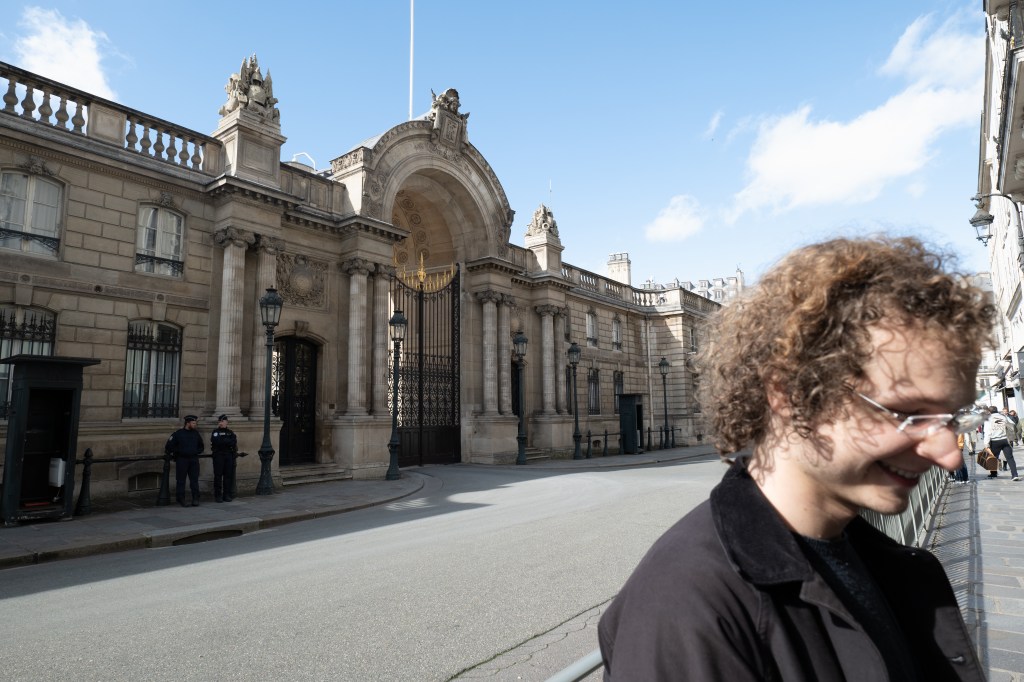
A: If I was the conductor, I would be nothing without my baton. My fist would not carry the same authority if not for the hammer in my hand. It’s very similar in the courtroom in which the sound of the gavel holds the entire power of the executive. In our case the entire speculative market. By the way, do you see this officier on the other side of the street? He has been watching us for a while now.
H: He’s not just watching us but the whole scenery, since we are so close to the governmental district. And yet he’s already exercising power, in the form of his gaze.
A: I wonder if he also carries around a hammer with him?
H: I’m sure he has the biggest hammer in Paris. What do you think would happen if one were to take his hammer away? Psychoanalysis would argue the gavel is ultimately (already) an element of castration. If you will, l’officier is castrated because he only carries out his duties, and has no real personal power. Without uniform he is stripped of any authority. Officialdom is castration.
A: You and your Freud. Before my career as an auctioneer, I wanted to be an ambassador for some time and was sent to a U.N. simulation in New York during school. Never have I felt like such a tool. In contrast to many of the others, who were enthusiastically waiting in the wings to stand up for an organization, for a country, I felt like a powerless accomplice. I remember very clearly slipping a note to my friend that said: This is not my world! A few days later we sat on a huge rock in Central Park and promised each other that we would both become artists and meet up again later in life in New York. I did not turn out to be an artist but an auctioneer.
H: La folie des grandeurs! What happened?
A: Maybe there was more of an ambassador in me than I thought. I noticed that I liked you better in my hand than a paint brush. Do you remember when we met?
H: How could I forget?
A: In art school I was looking for a new hammer to hang my works on the wall for the annual show. Just when I lifted my arm to catapult your head onto the nail, I stopped in my tracks because I had the feeling that you always saw yourself as being destined for something other than a craftsman’s hammer. You saw yourself as a symbol.
H: I had different dreams. I imagined that my wooden appearance, with my thick head and two sides, meant something other than mounting in the service of hiding a nail. I wanted to have the last word!
A: And I wanted to create value! But – franchement – artists are not the ones creating market value.
H: You saw my potential, brought me to the carpenter and had me modified.
A: Just like Geppetto and Pinocchio! And now look at me, sitting here and talking to my own hammer. I feel like one of these horrible paintings that we saw yesterday at Centre Pompidou.
H: I had a good view from your shirt pocket.
A: Très surrealiste!
H: From my point of view, I really liked the pictures. They sell well. They are en vogue because we have reached the point of escapism again and artists still haven’t found any other answer than to escape into a dream world.
A: I can definitely see the reaction to fascism at the time, but I don’t feel like I see a red thread to today’s art production. I can’t get much more out of Surrealism than psychoanalytical pretense.
H: I see it differently. You were talking about speculation earlier! Since I am part of real but also speculated value creation, I have a good understanding of when fiction becomes reality. The surrealists recognized and investigated this early on – how the two actually always overlap. Especially in times of fascism.
A: For me, the exciting thing is the moment of value creation that came about when a group of surrealists came together. Writing their own manifesto and setting their own value.
H: That’s right, they wrote their own history.
A: I recently listened to a podcast in which the thesis comes up repeatedly that there are times when it is the best strategy to join forces as cultural workers and there are phases in which the whole thing breaks up and the individual can make the most capital.
H: Which phase are we in right now?
A: Perhaps we are similar to the surrealists in this way, because I think collective mobilization is the mode of our time. But you have to take a closer look. If we look at the algorithms of social media, we find collaboration and individualization rewarded at the same time.
H: Interestingly, our artist friend commented on the surrealists, saying that they were a supposed group and yet they all wanted to be exceptional geniuses at the same time. They painted folding pictures and yet built their careers alone.
A: Oh, look! L’officier has been exchanged with un autre officier. He is wearing airpods!
H: What do you call a French candy with blond hair?
A: Umm….
H: Brigitte Macaron!
Silence.
H sighs.
H: I have to tell you something. I’m going to leave you.
A: Excuse me? Then I’ll have to bang on my podium with my bare fist from now on?
H: I’ve been meaning to tell you for a while. I was just so distracted by all the limousines speeding past us here in the government district. So. You always hit me too hard on the head. I’ve told you that a thousand times. I have an offer at the courthouse, at the Palais de Justice. They’re handing down so many judgments at the moment, they need another gavel.
A: Ah yes, they are preparing a huge trial against our biggest competitors in the auction world. I’ve always known that they’re corrupt charlatans.
H: Yes, look at it this way, I’ll keep banging my head on your behalf. They also offered me a new apartment with a velvet cushion to rest my head on.
A: That hits the nail on the head! But Hammer, I can’t blame you. We’re both careerists. I don’t think much will change for you. Even a judge acts with a certain amount of drama. But I’m scared at the idea that from now on you will no longer judge the value of art, but the value of people.
The auctioneer bangs her fist on the table.
The hammer hits the auctioneer on the head and takes off.
A: That’s right, beat it!
 Divine Transportations